Showing posts with label Time Travel. Show all posts

Wednesday, November 7, 2012

Rosy's scrawled book recommendation: The Nightside series by Simon R Green

The Nightside series
Simon R Green

Books 

Something from the Nightside
Agents of Light and Darkness
Nightingale's Lament
Hex and the City
Paths not Taken
Sharper than a Serpent's Tooth
Hell to Pay
The Unnatural Inquirer
Just Another Judgement Day
The Good, the Bad, and the Uncanny
A Hard Day's Knight
The Bride Wore Black Leather

(Plus some short stories)

Blurb for Something from the Nightside

John Taylor is not a private detective per se, but he has a knack for finding lost things. That's why he's been hired to descend into the Nightside, an otherworldly realm in the center of London where fantasy and reality share renting space and the sun never shines.


Publishers
ACE (US)
Solaris Books (UK)

Rosy's scrawlings on The Nightside series
This is one of my favourite kick back on a Friday night series. Plus any other night, of course, but you get what I mean instantly when I say Friday night. This is B-rated monster heaven for many a reader or even avid movie watcher written with style and kept short and snappy. My saying B-rated might make you think the writing isn't up to par or the subject matter lacks a certain something in morals or life lessons but you'd be wrong, although you could ignore all that if you like and just focus on the monster mayhem. The B-rating is entirely due to the monster movie parallel that pairs it with greats like Evil Dead: one of the ultimate Friday night movies.
In this series you'll find all the best and some new creatures, beings, monsters and gods and their relationships within the under-London/alternate-London/alternate-world or dimension called The Nightside are anything but friendly. Schemes are spun for power on a day-to-day basis, deals are done for survival and everyone is on the run from some other monster, which includes the most powerful of The Nightside. The one who inspires such fear in most, as well as a hefty dose of hatred and disdain amongst other things, is John Taylor. He's an odd pick for a monster of monsters considering he's mostly human, mostly reasonable and on the run himself. Still, he manages to play the role of the monster's monster rather well. His ability is truly fearsome, when he chooses to use it.
Within The Nightside series almost everyone has an ability that sets the apart and few are human anymore, if they ever were. But the general inhabitants of The Nightside aren't those that John Taylor tends to play with. Instead he deals with the god of the razor blade, post-apocalyptic monsters from the far future, the adventuring hero of heroes, the god of skin and other such worrying creatures. Not to mention a rather warped version of Merlin, a son of the devil. John Taylor is mostly unwanted and unwelcome so in order to deal with any at all threats are slung and some followed through on. Blood and gore flows, darkness is held back (just), and the worst mother of all time is sent packing (John hopes).
The Nightside series, as you can probably now tell, is a Friday night B-rated horror comedy movie writ large. And, like Terry Pratchett's light fantasy comedy works, there's much wisdom and insight to be found if you choose to pay attention. Best of all though, this series is fun, quick to read, engaging and well-rounded. The Nightside may be a contained domain but its presence and impact bleed out not just into the world beyond but into your mind as you're reading. It is a dark fairyland for the morbid and playful to enjoy.

I'd recommend this series to: those interested in quick paced dark fantasy, dark comedy and monster stories. Also, anyone who typically watches movies and TV shows rather than reading books will find this a great way to crack into the world of books.

Friday, August 3, 2012

20 of the best fictional time travel methods


1. Time Machines
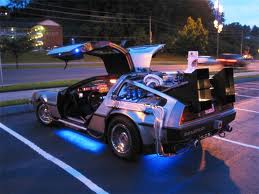
Part magic, part science and all gold. These are a staple of the science fiction world and a good choice for anyone starting out as a time travel explorer or anyone wishing to write science fiction classic style.

2. Wormholes
A favourite for travelling not only to the future or past but also incredibly long distances. This multi-purpose plot device will usually get you out of any sticky time-space situation even though in reality it would be the end of your story if you encountered one.

3. Localised Time-Space Manipulation
Best recognised in the Terminator series, this is plausibly scientific until you try to explain it. So don't explain it, just show it in action as the action is impressive enough.

4. Slingshot Around The Sun Or Black Hole
You can also use other cosmic bodies with fictionally sufficient gravity.

5. Speed Of Light Manipulation
Time slows the closer you get to the speed of light so therefore travel into the future or past is fictionally possible. This is a favourite amongst the science-fiction writers but it hold less credibility with an audience than you think. Despite this, nearly all those in the audience will forgive and forget for all the other scientific gold you serve up.

6. Travelling Through The Bermuda Triangle
Warped time-space or magic triangle, no matter the explanation for the Bermuda triangle, as soon as you mention it the audience will accept the idea. The concept is so ingrained that you can get away with pretty much any explanation as anything new is entertaining.

7. Cryogenics Or Cryosleep
Although this is highly unlikely to occur in the real world there is enough credibility to this time travel method to be used in the most hardcore science-fiction works. That slim possibility of cryogenics being used successfully in the real world is what makes this a preferred one way time travel method.


8. Soul or Life Essence Transferal
This can be drug and/or tech induced.

9. Reincarnation
The characters clearly or partially remember their past lives.

10. Reversing The Earth's Magnetic Field Or Spin
Highly improbable scientifically but good enough to support a light hearted story.

11. Drug Trip Or Hallucination
Can be used to question reality. Anything experienced may not have actually happened.

12. Afterlife Experience and/or Coma
Can be used to seamlessly expand the scientific universe into the mythical.

13. A Secret Magic Door
For fantasy stories only, preferably romance and children's stories.

14. Genetic Ability
Belonging mostly to the world of comics but occasionally of use in literature: see The Time Traveller's Wife.

15. Touching or Reading Old Artifacts
These may be relevant to the character's past adventures or just the character's future/past love etc.


16. Talisman, Magic Item or Magic Spell
Best used in fantasy stories and children's books to add wonder or the darkness of a witch's black magic.

17. Unexplainable Scientific Time Travel Properties To A Substance
This is very much like the use of a talisman or magic item except it can be used in a magic-less universe.

18. A Spirit From The Afterlife Guides The Character's Travel
Can be used to expand reality to incorporate both time and extra dimensions as well as an afterlife plane of existence.

19. A Fall (present) and Rescue (past or future) Often With A Period Of Unconsciousness In Between
This method is similar to the coma induced time travel.

20. Self Hypnosis
Similar to the drug induced or hallucination induced time travel, anything experienced may not have actually happened.

Note:
You can also use any combination of those above to justify time travel.

Thursday, March 22, 2012

Time travel in fiction: structure and function

Time travel in fiction is often used as a plot device for discovering what would happen if a particular issue in society, technology or otherwise went unaddressed. If not used for this purpose then time travel is used to take the reader to another time and space where more opportunities are afforded the writer to weave the tale they want.

Suspension of disbelief is needed in any writing of time travel simple because it isn't (as yet - hopefully) possible to travel in time. First you have to suspend your disbelief while read of the time machine's structure. As we can't travel through time and have no real technology for it, any technology portrayed in fiction will be fantastical.

From: forevergeek.com

From: 10yl.blogspot.com

From: alienhippy.wordpress.com

Then, as a reader, you need to suspend your disbelief concerning the makeup of the world you are taken to in order to focus on the issue at hand; what the protagonist, the world and the antagonist will reveal as issues to address in our current society or our own hearts.

But what you need to develop the most in reading or writing time travel literature is not your imagination or your ability to suspend your disbelief. What is needed is the ability to think logically about the structure of time. Without this, the story unravels for writer and reader alike. 

And by that I don't mean the way scientists analyse time, using relativity, quantum fluctuations, the expanding universe, the deconstruction of what is 'now', the hypothesis that there is no past or future but rather just now, the uncertainty principle or any other theory related to time and space's structure (which is all related to gravity and energy and takes far more time and mathematical ability to explain than I have).

I mean that a writer must choose whether the past can or can't be changed and what overall structure time has.

Time structures:
  • Time runs in a single stream and no matter what you do nothing will change. Time travel to the past is impossible but travelling to the future is possible. This is a little problematic if you consider that the future's past can't be changed either so all actions taken will be tied down as the final act. Using this structure would allow a writer to move in leaps forward in time but otherwise all other actions are as grounded as in normal fiction. Travelling back from the future is impossible. Perfect for Robinson Crusoe type books, where the protagonist is stranded in a new land.
  • Time runs in a single stream but you can travel to the past and future and change events but the past will remain as it is currently structured as any actions taken were always going to be taken. (Futurama is a perfect example.) The writer is tied down a little with regards to the story's own internal structure but there is plenty of room for the imagination to fly. The time stream remains a single stream but loops form in it as time is travelled. What always bugs me about this structure is that when time loops it has to re-join in the past and split when reaching the present (one stream looping back and the other moving forward). The loop is both separate and connected at once and although the stories created using this structure are often pleasing, I just can't stand that last little quandary.
  • Time runs in a single stream up until the point of time travel. The past and future can be changed and any changes made can be changed back by travelling further back and preventing the initial change. Even with these travels time remains a single stream so there is no way of moving from one time to another without altering events. This is where the 'don't step on anything' comes in as the changes can be unpredictable. In fact, making changes is unavoidable so limiting them is the perfect plan for the survival of the present and future.
  • Time runs in a single stream up until the point of time travel. The past and future can be changed but by changing the past you create a new time line separate from the previous. This will allow the protagonist to travel across times as one would parallel universes but by either travelling back to a particular event and then forward again or by leaping across the 'gap' or 'void' between times. To construct worlds using this requires more suspension of disbelief than any other as the structure of time itself is moving away from the understandable. While everyone is becoming quite used to the idea of parallel universes, parallel times is still a little hard to understand as they aren't that different to parallel universes but they can be changed by time travel where the universes usually aren't (unless the writer is using both parallel universes and time travel in the structure of their book, thereby melting the brain of all their readers).
  • All times appear together as a result of time breaking down. The structure is a flat time-space inclusive of remnants of all times and spaces. The structure is simple in that there is one time yet complex in that all times are now included and must be represented. This is where equal amounts of creative play and science blend.
So before you start out writing a book including time travel, make sure to pick the structure that suits your story the most. If you choose a very complex structure of time you will have to plot out all the ramifications of each action and stick by them closely as a reader will become incredibly lost if you step outside the structure of time in your book to write whatever you want to happen, disregarding what should happen.


Just a note: Editing time travel books is taxing on the brain. Good luck if you are. I mean it.