Showing posts with label Writing To Deadlines. Show all posts

Thursday, July 19, 2012

Working while trapped physically, mentally or by obligations

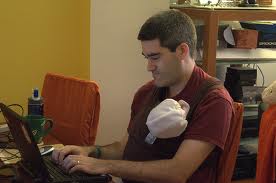
You can hug and type at once. Well, hug of a sort.


Does this sound like an odd topic? You should see my current position in life. I'm a cat warmer apparently so I've only got my hands partially free to type. Now, there are several ways you can be trapped physically. You could be bound to the house due to a baby or young child, you could be like me and at the whims of various pets or there could be something else stopping you from getting up and moving about as you'd like. Whatever it is, usually it saps time as well as space from you. And as much as you might want to live like a hermit writer you probably can't.


This means that working becomes something you need to do around the movements of others or your other problems. Its a game of negotiation with oneself, essentially. You sort out what's most important to you first and then delve into your work. What's most important should always be such things as family, animal care and even the little things like feeding yourself and making sure the washing's done.


Most of the time though, when you're writing, it is the story that seems most important. Not to mention the deadline, whether self-induced or otherwise. You're understanding of what is the most important thing becomes confused when you're in the midst of things, meaning that what traps you and what interrupts you becomes a thing to fight bitterly. This can lead to you neglecting those around you, destroying the friendly relationship you have with your pets, letting the house sink into disrepair, possibly attacking people for being so irritating and even  attacking yourself for not being able to control everything like you think you should.


If there's a baby in the house you probably also feel like your mind's turned to moosh so that even if you have some spare minutes here and there to write you couldn't think of a thing to write about if your life depended on it. Sleep deprivation and other concerns do that. But such times don't last forever. Also, laptops come in handy here so that no matter where you have that lucid moment the laptop is ready so you can write. And don't forget the pen and paper in the pocket so you can jot down any idea you have while on the hop (though sometimes actually getting pen to paper is difficult).


As I mentioned before, working while trapped is a game of negotiation. You have to give up parts of yourself in order to get other things done and you have to sacrifice one project for another according to how you're trapped at any particular moment. Things often don't go your way and the day's plan has to change but consider it this way. You're going to get it all done eventually anyway so the main problem you'll have is meeting a deadline for one particular project that is hard to do due to repeating circumstances.


In such cases you could negotiate with the ones setting the deadline or put your foot down with regards to any outside influences that are trapping you. Cats and dogs get thrown out into the yard, baby's sent to a baby sitter for a day's minding so you can really crunch through your work and older kids can go for a sleepover or something else fun (in return you might hold your own later so the other kid's parents get some time off too). If you're in the wrong house or minding someone who's terribly sick then a laptop and working during the other person's sleep or entertainment times is acceptable (particularly if they aren't really noticing what you're up to).


In cases of caring sometimes the other person just wants company and not talk, wants a distraction of their own so would like to help you or is relatively unaware of everything so having a hand to hold is the most they'd like. If you're in such a position as caring while meeting a deadline you just gage the other person's situation and needs and meet them. It may mean sacrificing a hand so you're typing one handed or taking half a day as a caring shift so that you can work the other half a day in a solid slog rather than be constantly interrupting your work for the other person or the other person's care for your work (however you see it at any particular point - yes, your view on it will always switch between the two so don't feel bad about that).


The aim is to negotiate some time and space for yourself to work solidly for as long as you possibly can before returning to the other important things in life. Saying that your writing is more important than anything else just because you're completely mentally stuck in the story is, and actively treating your writing as such, will only make you regret quite a few of your actions and missed chances in life. Overall, regret is something best not felt though it is rather unavoidable for most of us as we usually regret some of our actions. Still, even though we all regret something or another so should be fine with adding more, we generally aren't. So try not to make writing the be all and end all, to the detriment of the rest of your life. But at the same time, don't forget to write whenever you can.


Taken with the Photo Booth on the laptop. Bib (blue collar) jumped off me after all that beeping so now I'm set to be scrabbled on again.


I hope this makes sense. I've been scampered on, curled up on, clawed, had a tail in my face and a cat bum on my arm and laptop all while writing this. It is too cold outside apparently. At least they've settled somewhat now into a purring mass but still, I'm trapped flopped over sideways with one arm free only from the wrist and I don't think I can stay like this for long. It'll hurt.

Sunday, May 13, 2012

Writing against the clock


In writing there are always more deadlines than expected, especially if someone else wants to publish your work. Sometimes the content ends up being forced and the final polish is nowhere near as fine as desired just because the piece, whether creative or informative, has to be belted out before the deadline is up. It can leave a writer discontented with their work and somewhat ashamed if it goes to print in such a condition.

But worst of all is when the readers pick up on the drop in quality. Reactions are normally negative. A reader only moves on to reading your next piece if they either love your works so much they just have to have them all. Or if they don't know you from a bar of soap so don't realise that you wrote a good piece and a bad one. Those that vote through purchasing, those that read only the good stuff as it were, tend to make judgements like "the author's lost his mojo" or "her work has little substance anymore" and then avoid buying or reading any further works you produce. No matter whether the quality improves or not. They are the once disappointed, twice as grumpy as necessary people.

In some ways you could say that the fault of failure lies with those who create the deadlines because they are the ones pushing for material to be handed over before it should be. Writing is an art and so every piece should receive the effort needed to make it of high quality, no matter how much is required. It is fair enough for writers to grumble in such a manner but as with most things, such an opinion is skewed by self-interest and over-absorption into the creative process rather than production.

So you could also say that it is the writer's fault because they're being too focused on their work being up to their own standards rather than acceptably marketable and publishable. If the writer would just do a better job of getting it all down in one take rather than faffing over little details which could be resolved by someone else then there wouldn't be a problem at all. Writing needs an audience because without an audience writing is just the scratchings of a loony talking to himself or herself. And if the writer had managed to create something in a certain period of time before then why not again?


In truth the failure to write to a deadline or produce quality work to a deadline falls on both the writer and the publisher. In the age where it is believed the quicker the turn out the greater the audience share due to the repeated exposure keeping works in the minds of the audience, those writing are coming under increasing pressure to produce works at a quicker and quicker rate. And because of the over-attention to the publisher's needs the quality is dropping.

For example, in journalism, the name of the publication becomes famous and most reputable by it being the first to publish 'the scoop'. To be the first doesn't just mean discovering the event first but scribbling up the details as quickly as possible and hitting send before anyone else in a competing publication does. Thus you get spelling mistakes, grammatical errors and chunks of barely readable material being printing. All because of the need to be first. 

You may have also noticed that to be the first to print the news what are practically fliers are being written and published rather that articles, with a full article to follow. This is supposed to ensure the publication got in first, snagged your attention so that you'll go back and read more. It's as though by being first they've appointed themselves the authority on the subject and wish you to believe they are too. But returning to read more does not happen nearly as frequently as the publications like. For many, just finding out whoever it is has died, for example, is enough. They don't need and aren't really interested in the details. For others, once they know an event has happened then reading on it in their most trusted publication rather than the first to publish is preferred. So audience members can actually be lost rather than gained through the time lag between flier and article.


But again, there's the other side of the coin that will remain as long as there are writers about. As all writers of novels know, you just have to go back and fiddle with the details just a little more. Yes, there are some writers who believe their every single word is genius but for the rest of us more level-headed sorts it is more about the effort of creating perfection than our works ever being perfect. A level of dissatisfaction and uncertainty will always be there and if possible we'd only hand our work in once we're assured enough.

Deadlines help to push a writer along but the best way to assure a writer that their work is acceptable is through having someone read and like what has been produced so far. Only when this stage is reached are writers comfortable with handing in their works. So to write to that deadline and be comfortable with the quality it is a good idea to have a trusted reader on standby, one who's willing to help you out no matter when, who will give you a yea or nay as to acceptability. An outsider's perspective is often the only way to go. And if the quality isn't good enough then approaching the publisher with your concerns early rather than late is a great idea. Don't give your publisher/s heart attacks if you can avoid it. Heart attacks are bad for business.

When writers and publishers think carefully on the pressures felt by the other party and adjust accordingly (giving small extensions and a helping hand through an editor or agent as well as writing to reach certain goals set by the publisher and listening to their requirements rather than producing only according to the writer's whim) works can be produced in a timely manner that are of high or high enough quality not to lose what audience has already been gained. So, for the writer, keep a mind on the publisher's need for sales, the roll of marketing highs and lows and the publisher's desire to maintain a good reputation (yours along with it). For the publisher, keep in mind that the writer will after a while have a complete mental breakdown if the deadline is too tight because sometimes it is simply impossible to write coherently under a deadline and meet it. Some flexibility is required for art to be produced. 

If everyone works as a team it usually works out well. If we all fight and squabble over faults and failings then we'll all likely lose out. And as the pressures increase, finding solutions other than tightening the deadlines might be required. Hopefully not to the extent of 'fliers' for novels (which I have to say that some short stories can read as) but something of interest to the various reading audiences about (games, role play, corsplay, signings, talks etc.).

And speaking of deadlines, mine is coming up. I have to scribble out a few more sentences, edit, find a picture or two to make it all look pretty, hope that my writing up to some sort of scratch and hit send so that I can go into the city for a Mother's Day tour of the NSW Art Gallery and a feast (I hope - dietary restrictions allowing. I just hate those days when you leave the house and find there's nothing you can eat about) in the botanical gardens.