Showing posts with label Female Characters. Show all posts

Saturday, October 27, 2012

Female pirates: mythological, fictional and real

A little while ago I ran across an article on sexism which just happened to reference pirates as a good example of sexism at play: by our perceptions of pirates as male and our reinforcement of this perception by creating stories centring on male pirates. Apparently the thought of pirates being female, pirate captains in particular, is a little hard to swallow. Well, this was not exactly a shock to me but I still hummed in disappointment over one girl's reaction to the idea of female pirates, which was to say that "everyone knows the best pirates are boys". Obviously, she didn't know enough about female pirates and she had also become blinkered by seeing mainly the male pirates having the stage when it comes to action and leadership. Now, I'm not going to weigh in on the sexism debate, at least not where pirates are concerned, as even in history the number of female pirates and pirate captains were less than those of males. What I will weigh in on is the spreading of information on female pirates so that you at least know of one of two interesting ones when confronted by the female pirate issue.

So here's a few female pirates, fictional and real, you might like and/or fear. There are definitely quite a few I wouldn't have wanted to cross...


The Chinese female pirate Ch’iao K’uo Füü Jëën from 600 B.C. who may be mythical.

Queen Teuta of Illyria who lived from 232 B.C. to 228 B.C. near the Adriatic Sea.

The Norwegian Rusila may or may not be fictional but is said to have fought her brother for the thrones of Denmark and Norway. She is also possible part of or the origin of the Ingean Ruadh or Red Maid from Irish folklore. Rusila also had a sisterStikla, who became a pirate to escape being married.

Princess Sela, who was the sister of the king of Norway, Koller, in c. 420 A.D., was apparently a skilled and experience warrior pirate. She fought to stop her brother Thrond from gaining the throne. She was eventually killed by the mann who could have been King of Jutland, Horwendil, but gave up the position in order to become a pirate. A man who'd been attacked by Koller only to see Koller dead.

The Norwegian pirate Alvid who lead many male and female pirates.

The Norwegian pirate captains Wigbiorg, Hetha and Wisna who lived in c. 8th century A.D.. Wigbiorg is said to have died in battle while Hetha became the queen of Zealand. Unfortunately for Wisna, she lost a hand in a duel and he career as a pirate is unknown from there.

The Swedish pirate Alfhild from post-850 A.D., sometimes said to live during the 5th century instead, is possibly fictional.

Ladgerda from c. 870 A.D. was apparently the inspiration for Ermintrude in William Shakespeare's Hamlet.

The English pirate Æthelflæd, aka The Lady of the Mercians, lived from 872–918 and was a pirate from 911-918. She was the Eldest daughter of Alfred the Great of England, a military leader of the Anglo-Saxons and commanded her fleets against the Vikings.

The French pirate Jeanne-Louise de Belleville was a pirate from 1343-1356 and was known as the "Lioness of Brittany". The worked to avenge the execution of her husband by attacking only French sea vessels.

The Irish Gráinne Ní Mháille, aka "The Sea Queen of Connaught", lived from 1530-1603. She was the Queen of Umaill, chieftain of the Ó Máille clan and a pirate. She appears in Irish folklore as well as Irish history.

The English pirate The Red Lady Veronica lived from 1500–1534 and was a pirate from 1528 - 1534. She never revealed her true identity and disguised herself as a singer and entertainer so that she was brought onto ships. Once alone she'd remove her disguise to reveal a top and pants, unusual at the time, along with her weapons. Once ready she'd then go kill everyone aboard and steal the ship.

The Morroccan pirate Sayyida al Hurra was a pirate from 1510-1542. She allied with  the Turkish corsair Barbaros of Algiers in order to control the western Mediterranean Sea at the time when Barbaros controlled the eastern Mediterranean Sea. She became Queen at the death of her husband and later married the King of Morocco.

The English pirate Lady Mary Killigrew was a pirate from 1530-1570. She was the daughter of a Suffolk pirate and wife of Sir Henry Killigrew who was also a former pirate. Sir Henry became the Vice-Admiral and was put in charge of fighting piracy by Queen Elizabeth I. While the husband was away Lady Mary took her household staff as ships crew. While Queen Elizabeth may or may not have know of this she was at least annoyed when Lady Mary attacked, took possession and sold a ship owned by the Queen's friend. Through means uncertain she managed to bargain for jail time rather than death. While she did give up piracy she apparently didn't give up being a crook as she proceeded to fence stolen goods from then on in.

The Caribbean pirate Jacquotte Delahaye was a pirate during the 1650s-1660s and was also known as "Back From The Dead Red". She had red hair and return to piracy after faking her death. While faking her death she dressed as a man for several years.

The French pirate Anne Dieu-le-Veut, aka Marie-Anne, was born around 1650 and was a pirate from the 1660s-1704 in the Caribbean and the Mississippi. Her nickname means "God wills it" as apparently anything she wanted she got. She married a pirate who was later killed by Laurens de Graaf. She challenged Laurens de Graaf to a duel but he refused. Somehow she ended up his common-law wife and they ended up pirating together.

The possibly fictional Maria Lindsey was a pirate during the early 1700s, operating on the Canadian east coast.

The Swedish pirate Ingela Gathenhielm lived from 1692-1729 and was a pirate from 1710-1721 operating in the Baltic. She was the wife and pirating partner of Lars Fathenhielm and when Lars died she took full control.

The Irish pirate Anne Bonny lived from 1698-1782 and was a pirate from 1719-1720 operating in the Caribbean. She apparently stabbed a servant woman with a butter knife, left home, married the pirate James Bonny and had an affair with John "Calico Jack" Rackham. She ended up joining Calico Jack's crew. Friends with Mary Read. There are multiple fictional depictions of Anne Bonny.

The English pirate Mary Read, known as Mark Read while disguised as a man, lived c.1690-1721 and was a pirate from 1718-1720. She was a Caribbean pirate after joining the British army as a man, going to sea and fighting the War Of The Spanish Succession. She later married and settled down but once her husband died she returned to pirating in the West Indies. She was captured by Calico Jack and, once her identity was discovered, she became friends with Anne Bonny. She ended her days in prison. She also has multiple fictional depictions.

Flora Burn was a pirate during 1751 and worked on the East Coast of North America.

Rachel Wall lived from 1760-1789 and was a pirate during the 1770s, operating on the New England Coast. Married to the privateer George Wall, she's thought to be the first American female pirate. Her husband and his crew we down in a storm in 1782 and she was later accused of robbery in 1789. She confessed to being a pirate and was hanged.
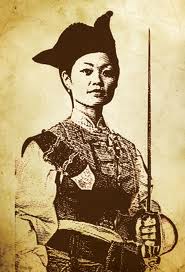
The Chinese pirate Ching Shih was active from 1801-1810. She'd been a prostitute but changed her career to piracy upon marrying a pirate. Upon his death she became the leader of the entire fleet of more than 1,500 ships, worked by 80,000 pirates. She controlled most of the South China Sea and defeated the British, Chinese and Portuguese navies whenever they attacked her. Eventually she was offered peace instead and retired to marry her second in command.

The English/Australian pirate Charlotte Badger, aka Catherine Hagerty, operated in 1806 and is regarded as the first Australian female pirate. She was a convict who helped seized The Venus from its captain while the captain went ashore and sail it to New Zealand.

Sweden's last pirate Johanna Hård was born in 1789 and active as a pirate during 1823. She and 4 men who worked as farmers followed the Danish ship Frau Mette in a fishing boat, requested water, boarded the ship and killed the crew in order to plunder it. The men weren't so lucky but there was insufficient evidence against Johanna Hård so she was released.

The possibly fictional Sadie the Goat, river pirate during 1869 around New York State, head butted and robbed her victims. She was also a member of the Charlton Street Gang. 

The fictional Gertrude Imogene Stubbs was said to be a pirate during 1898-1903 in the Kootenay Lake and river system in British Columbia. She is the result of an April Fools joke mistakenly believed as fact.
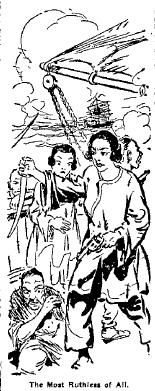
Lo Hon-cho from East China was a pirate during the 1920s. She commanded 64 ships and was reported to be the most ruthless of all China's pirates. She attacked villages and fishing fleets around Beihai, imprisoning young women and selling them into slavery. A Chinese warship destroy 40 ships in her fleet in 1922. She was later handed over by the remaining pirates in exchange for clemency.

Lai Sho Sz’en who was a pirate from 1922-1939 in East China and controlled 12 ships.

Huang P’ei-mei who was a pirate from 1937 to the 1950s in East China led 50,000 pirates.

The Fujian province (China) pirate Cheng Chui Ping, aka "Sister Ping", was a active during the 1970s-1990s in the South China Sea. She smuggled thousands of Chinese immigrants to the U.S. and Europe. She was caught and is serving 35 years in jail.


Bêlit from Robert E. Howard's Queen of the Black Coast, a Conan short-story.

The anime character Emeraldas from Space Pirate Captain Harlock, Galaxy Express 999, and Queen Emeraldas by Leiji Matsumoto.

Dragon Lady from Milton Caniff's Terry and the Pirates comic was inspired by Lai Sho Sz’en.

Morgan Adams from Cutthroat Island.

Mary "Jacky" Faber from Bloody Jack.

Elizabeth Swann from Pirates of the Caribbean.

Mistress Ching from Pirates of the Caribbean: At World's End.

Angelica from Pirates of the Caribbean: On Stranger Tides.

Nami and Nico Robin from the manga and anime series One Piece.

Ruth from the Operetta Pirates of Penzance.

The Chinese female pirate captain Missee Lee in Missee Lee by Arthur Ransome.

Ezri Delmastro and Zamira Drakasha from Red Seas Under Red Skies by Scott Lynch.

Elena Dugan, aka Lady Galbraith, in The Seas of Fionnghuala.

Nancy Kington and Minerva Sharpe in Pirates by Celia Rees.

Janme Dark from Aoike Yasuko's Sons of Eve manga series.

Space Pirate Sheila from the Space Thunder Kids anime.

Captain Marika Kato of the Bentenmaru from Bodacious Space Pirates.

Blackboots from Here Comes A Candle by Mary Hanson-Roberts.

The Surprisingly Curvaceous Pirate from Gideon Defoe's The Pirates! series.

Thursday, October 4, 2012

On the conversations of women in fiction

Big Bang Theory, while being fun all round is guilty on so many charges of stereotyping I don't know where to begin and whether pointing out the stereotyping against women only is too blinkered as there's so, so much applied to the men too, along with the careers, the nerdishness etc.

How often do you read or watch conversations between women in fiction and find that they're about men? Far too often, as far as I am concerned. And I'm left wondering as to the reason why. Do men need the emotional status of a woman with regards to their relationships explained in full, just not to them? Do men find it flattering that they're the centre of a conversation? Is it just unimaginable that women would talk about anything else? These questions all sound as though I'm assuming men are all 'bad' but that's not the case. It is more that for the purposes of fictional relationships there are certain internal emotions that need to be explained to the reader. And as often as not, these relationships and conversations are being written by women so seeing the questions above as anti-male isn't quite correct. What those questions come down to is: what to we think males can tolerate with regards to female conversations and emotional relationships as well as what do they expect? Also, for those works written by women for women, why do such trends stick? The how, where and why of conversations between women about men are complicated questions to answer.

First though, the what.

In fiction there is a tendency for conversations between women to revolve around men. And if this isn't the case then obviously it must be about the body, shoes or children. I say obviously as these are some of the main stereotypes about women and their conversations. Of course, stereotypes don't come out of no-where. It is indeed the case that women are quite concerned with children and family issues when they have or want them. It is also quite common to collect shoes as these are things women not only expect to wear but wear as they make a person feel better about themselves when they're of quality, just like a good suit makes a man feel snazzy and of worth. Women also do talk about their bodies when problems occur but so do men. Please reference the constant flood of man flu complaints if you don't believe me. Also, women gossip but so do men as this is an essential part of being a pack creature. One must communicate and understand everyone's current state as much as possible.

So, why the issue with fictional conversations between women largely being about such things? Well, real conversations between women run in different orders of importance and some of the above topics are actually rarely brought up. First of all, men. Men aren't brought up like "Hi, how are you and your relationships going?". They aren't at the top of the list even if they are of importance to a woman, which is definitely not always the case. There are other things to talk about like house plans, work issues, travel plans, the latest movie or book consumed, this awesome restaurant they just tried, what was done during time off, whether studying is going well or is a pain, who's being a pain and who's doing well, dreams and aspirations, how the business (big or small) is going and things of that nature. And if there's a hobby involved then there's usually a massive conversation revolving around that so there's plenty on gaming, movies, books, collecting, gardening, cooking, arts and crafts, pets and pet breeding etc etc. In other words, a general meeting of the minds and swapping of ideas. On top of that there's conversations of science, sociology, philosophy, psychology and all things related to life and life views. Shoes fit somewhere in the sub-types of collecting and as you have probably encountered, women will collect anything from dolls to video games.

There's also no definite correlation between a woman being unhappy so the relationship must be on the rocks as often found in fiction. There are many reasons a woman would be unhappy that take precedence over relationship issues and these issues are rarely brought up. Things like live conditions, health, education issues, work issues, harassment problems, difficulties doing tax before the tax office comes knocking, paying bills that are outrageous, dealing with companies that assume you aren't the person to deal with, issues with convincing others your worthy and intelligent despite being female and so on and so forth. Some of these might seem odd to those men reading this, mainly as you've probably not thought such things happen often enough or are that big of a deal but this is just about the varying reasons for a woman to be unhappy that aren't connected to relationships of any sort (other than by the assumption that if a woman has a partner the man is in charge of bills and company dealings). And if you don't believe such things as harassment, downgrading or disrespect occur often enough to women to be topics of conversation then think again. Seriously. And pay attention to what's going on around you.


Ah, two powerful women trying to talk about something other than Booth and sex... Failure is written all over Angela's face. Is it really because Bones is so inept in conversations? I wonder... Some of her conversation starters sound really interesting.

After and with all of the above comes conversations of the child, the first issue of the day if there's a child about as children always come first. These conversations usually sound something like this to begin with:
"Hi, how are you?"
Sigh, "It's been rough. The kids were mucking about and they set fire to the kitchen curtains. I put it out but the whole kitchen area needs fixing. So I rang the insurance company and the bastards only want to talk to ... as his name's on the account. Never mind that I'm the one always paying the bill. I've been trying to catch ...  while he's not working and can answer the phone but he's stuck in meetings so I haven't been able to arrange anything. So I went to the hardware to get a few things and ..."

Ramble, ramble, ramble and on to problem solving the insurance company and figuring out how to get the kids in line. It is usually like an information dump. All the crap that women have been dealing with by themselves and have had to smother to some extent in order to get along with said partner and children. There's nothing so neat and tidy as: "The hubby/boyfriend shouted at me today. I don't know if he loves me anymore. What do you think?" To be perfectly honest, women rarely talk about such things as they're very private issues and women are in fact aware of the gossipers amongst them. I should point out that there is a big difference between a conversation between women and gossiping. One does not equal the other. Don't think men don't gossip either. Men are terrible gossipers when they get going. It is unrelenting, and if they draw an opinion of you... Whoa Nelly, you aren't getting rid of it quickly.

So that's what a conversation sounds like if kids and partners exist in a woman's life. There's often a lot of frustration involved and relief at being able to talk about it all. What do they sound like without kids and partners? Well, the conversations aren't generally about shoes or periods. Forget that. And none are done in the nude unless the conversation is between two lesbians (I mention this as I just read an eye-roll worthy scene about two women talking about a man while nude that ended up with one woman kneeling over another - tits in face - and then one tickling the other. Neither were lesbians and I can't even imagine this scenario unless the two were lovers and ultra gooey lovers who had pet names for each other and wore matching clothes... I've never met anyone vaguely like that by the way). The topics of conversations for women without men or kids usually revolve around work, travel, partying, social occasions, friends, health issues, dreams and aspirations, latest entertainment, collections and so on. Basically all of those conversations attached women with a few variations according to freedom from kiddy related obligations that suck up time like a black hole.


...   See what I mean? This is from a 500 up edition strong manga called Bleach that's been converted to anime and is hugely popular. I should mention that the females in this manga, while occasionally good at fighting do not tend to match up or be portrayed realistically (fantasy fiction realism that is).

The conclusion of all this is that the portrayal of women's conversations in fiction is fairly blinkered and the topics rearranged in importance and emphasis, with a great many dropping away into non-existence. Not to mention that these conversations are often portrayed as light, fluffy, of little importance and an annoyance or something to be laughed at.

Why this has come about is likely due to the following (in no particular order):

  • Cultural expectations - deeply tied into the creation of stereotypes, cultural expectations are what we expect women to be. Our expectations deeply affect how we women and what is demanded of them but these expectations can often be damaging and restrictive.
  • Gender stereotypes - seen as the norm or standard when they are hyperboles or blinkered view points. Gender stereotypes come from cultural expectations and acceptance that's built up over generations. They also change somewhat though the eras but often are some of the last things to change with any social or cultural development, mainly as stereotypes can be used as weapons to deride or downgrade (weapons are always useful as we're a fighty bunch).
  • Writing trends - the publishers and producers guide writers and creators to create stories that meet audience expectations and the audience's ability to accept. The writers and creators follow the current popular or fashionable styles in order to gain acceptance from publishers and producers and/or market share with a primed audience.
  • Audience acceptance - the audience has grown to accept this type of conversation the most so writers and creators appease the audience by giving it what it can accept. 
  • This will increase the popularity of a story as it doesn't challenge the audience too much.
  • Audience expectations - the audience has grown to expect this type of conversation the most so writers and creators appease the audience by giving it what it expects. This will increase the popularity of a story.
  • Creator bias - the creator writes what is believed to be real but it is in fact rather skewed. The creator writes unrealistic scenes as that's what the creator wants women portrayed as for various purposes from money through to personal belief.
  • Plot necessities - the conversation has to go somewhere to explain the characters' internal feelings. The character needs to be featured but there's little personality attributed other than stereotypical ones.
So, with such a complicated mess causing the fictional conversations between women to be so skewed, can they be fixed? A short answer: yes. If writers and creators develop stories with women portrayed in better light then trends with change and audience acceptance and expectations with change and from there culture slowly changes. There are a few difficult hurdles along the way like our own internal bias and selling a product that isn't currently of fashion but may set one instead but what's life without a few hurdles?

And while we're at it, why not even the casts out, let women fight and plan on equal footing, throw aside the far too overt sexiness of the current powerful women set and go for the sexy as she is no bullshit all out power broker or fighter? Sexiness is in the confidence more than the black leather, at least for those who aren't teen boys f*p*ing away. Why not try to writing relationships that aren't stuck in the early high school "does s/he love me?" stage? Why not try writing relationships where the woman holds the power and makes most of the decisions? Action heroines aren't the only ones capable of running a show. Try to imagine a relationship not revolving around nagging, money and family planning. You'll find a pleasant surprise waiting. There are a few ground breakers out there but more is required. But if all this can't be done, please drop the teary conversations on men, the raving conversations on shoes and the cringe-worthy ones on periods. Please. Give me a break, especially on the shoes front.

Thursday, September 6, 2012

On females, their weapons and men in paranormal fiction


There is a trend in the new genre of paranormal fiction for females to wield weapons and impress others with their strength, not always physical. For those not in the know, most new additions to paranormal fiction are written by women for women just as fantasy fiction was taken over at one point by men writing for men. It is another wave of that sort that will slowly erode away only to reform into something else. So yes, the trend of women wielding weapons and being strong of character and sometimes actually physically strong is perfectly understandable. Every woman likes to be taken seriously and respected for their strengths so it is obvious that characters of the like appeal to a female audience.


What is interesting though, is that there is a bit of a divide going on between the weapons wielded by the young female characters and those by the older (not old just not teenage). In teenage paranormal fiction it is actually quite common for the female to wield the men with powers as their weapons rather than picking up a stake, knife (see what I did there :P), gun, crossbow, sword etc. The young females, of whom it is sometimes possible to call them women but mostly they are still girls, befriend of romantically entangle themselves with a man of werewolf, vampire, hunter or other paranormal or supernatural nature and when trouble hits they call for help and then send the men out to solve the problem. Granted, it isn't always written as such and is portrayed more as co-working or co-dependence or even being trusting and relying on someone. None of which are exactly bad but the message can easily be misinterpreted, especially when there aren't so many young females fighting their own battles whenever possible.


There is one version of this weak female lead that almost gives them power. And that is the version where they play the mastermind, the one openly calling the shots and being answered to rather than the one pulling strings and making puppets out of others by wielding emotions (I call such behaviour emotional blackmail and manipulation). With being able to call the shots is supposed to come power but such power is limited if you can't act on it yourself. As soon as anyone decides not to play along all the power fades away and the female is left to scream, cry and bewail the loss while begging for help. Such situations aren't always portrayed but they do appear often enough for dramatic purposes. I have little sympathy in such circumstances as I just want to see the character use her brain and pick up a weapon too.

Of course, there are young female supernaturals and paranormals who can hold their own but they run into the same old problems they had when human (if they were) and that is that despite the upgrade in strength and fighting skills they often remain weaker and less politically clued in than the men in the pack, flock, group or whatever. Young females newly introduced into a coven suffer the same problems but at the hands of older and more ferocious women and unfortunately for young coven members there aren't any men to go begging for help from.

Older unprepared women in fiction tend to go running for the nearest knife block to pick up the biggest, sharpest knife they can find (not always the best choice but that's another point entirely) rather than scream for help and get a man to save the day. At a pinch they might even have a gun about, a heavy frying pan or a mop that can be broken and used as a stake. Men of any paranormal or supernatural status tend to spring to mind after all these choices have run out. It is in the older unprepared women that you see what the average woman nowadays would do in such a situation. Doors would be boarded, the old softball bat pulled out from under the bed and the kitchen would instantly change from a place for cooking to a weapons stash. Not to mention the chemicals lying about the house, if they know how to use them. In the unprepared the everyday objects find new (or old) uses and that edge of practicality that we all love and respect in one another comes to the fore. Romance is out while manipulation of the man is pointless and too slow. Instead, give a woman a weapon and a place to defend herself from. Especially if she has to defend others.


It is from the older unprepared woman that we get the most go-ho weapons laden female characters from in paranormal fiction. The unprepared woman's dream as shit hits the fan is to have been prepared and to have better weapons and more of a clue as to just what is happening. So in paranormal fiction you find a lot of the older women have exactly that. They wield those knives, guns, swords, crossbows, wands, fangs, claws, fighting skills, knowledge and powers with great gusto and only some care as to the consequences. And of course, having someone to protect makes them just that little bit more dangerous again as will always be the case. Rarely do you find lady fighters who hold back. If the older woman doesn't initially pack a weapon or wield a power that will let her survive it isn't very long before she learns her lesson and does. Ladies don't remain ladylike in this manner. They might be polite and a little freer with their squeamishness but they will still pack poison, knives or a small gun to protect themselves and others and they don't exactly hesitate to use them. Meaning ladies are dangerous too so don't judge them when they're fretting over which hat, shoes or dress to wear.

The current divide in the choice of weaponry in the young and old is something of concern, at least as I see it. One sort teaches you to be co-dependant and reliant, which all seems well and good but when life gets extremely tough you need to know that you can stand on your own and fight on your own. Co-dependence and reliance are things to be found after sorting out just how strong and capable you are. Why? Because you can't protect anyone if you just rely on them and never do anything useful yourself. If you haven't found your own strength yet that just means you're still a child.


The other sort of life, where you only rely on yourself and never branch out to rely on others or work as a team with others, is also a tad worrying but not nearly as much as being a screamer. Being one to work solo is fine usually but everyone has their strengths and weaknesses so working as a team might help to cover some of those weaknesses and help make everyone less vulnerable. That's the essence of fighting in and as a pack. Humans are both solitary and pack animals. We need others now just as we always needed others. Yet there are some of us who prefer to be alone and can easily survive like that, once they've been brought up and gain the knowledge. But they are few and far between. In reality there are few who will work totally solo and disregard all help when its offered or even all that's produced by someone else (for the extremists). A solo heroine is, when looked at this way, completely unreasonable too.

But I will say this. I'd damn well prefer to be a prepared, weapons wielding woman or even an unprepared but practical one than a screamer. Screamers just end up dead or deeply regretting they didn't rely on themselves more. They are the teen female red shirts and writing or portraying them as teen heroines isn't a great idea. Encouraging foolishness and immaturity is how I see it. Such characters have a lot to learn and need to be shown actively learning it.

And I must say, I just cannot bring myself to respect an older woman acting like a teen screamer. At least run to the knife block. Then men aren't weapons, they're also ones to protect if you care about them.