Showing posts with label Fiction Made Real. Show all posts

Wednesday, August 29, 2012

Tips for making steampunk goggles

There is an art to steampunk goggles but once you get an idea of where to start in making them, let alone imagining them, you should be able to create a pair fairly easily.

The idea is to combine metals, preferably bronze or silver, and leather. If you have an old leather bag you no longer use you can either take a strip from it to make the strap or modify a loose handle that incorporates a buckle. If you don't have any leather about, don't buy any new leather but rather search out old beaten up leather in a second hand store. The softer the leather the better. When making holes for the buckles you can use a nail punch and a hammer or mallet. Alternatively there are fabric or leather punches that you can use. As for the buckles, buy an old buckle and fold the leather over the right side. You can stitch the leather with strong sharp needle and thick thread (may require some strength) or you can join the leather using fold-back pins (you will need to make a small cut to push the pin through) that are covered with material on the inside to stop them from scratching you.


Alternatively you can make spyglasses and hang them on a strap around your neck so that you only need to locate a leather strap, some swimming goggles or a pair of protective glasses metalworkers or woodworkers tend to wear. Just head to a hardware and you'll find a cheap pair. Then add knobs and nodules, the ends of small cans and some spay paint, layered if you like (as above). A strong glue is a necessity.


And if that search proves impossible then choosing a strap that's made from brown or black elastic is best. If choosing black then match the colour of the goggles to the strap by including black. The dominant colours of the steampunk version of the Victorian era are red, brown, bronze, gold, silver and black. Metal is preferred over plastic but we all make do. If you don't want to work with metal then spray painting and lacquering a metal paint on might be an easy option.
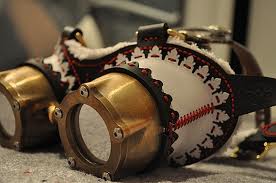

Eye glasses can become more feminine if you add smaller, more intricate patterns rather than chunky techy type knobs, lenses and gadgets. While any pair of steampunk glasses would suit there are occasions when a more feminine pair is in order, such as when matching the goggles to a Victorian-style steampunk dress rather than pants and a shirt.


For a more futuristic or space-adventure orientated goggles it might be nice to start with ski goggles, possibly tinted. Not all steampunk stories are based on Earth or even during the Victorian era. In such cases it is all about Victorian technology being in use or being the basis for the current technology. As such, modifications like the above are perfectly acceptable.


Going this far may shock those seeing it for the first time though. The space based steampunk goggles here do tend to blend seamlessly with French horror (often romantic in some way) stories and cyborg stories. I quite like these for a steampunk villain's goggles.


Speaking of steampunk villains, here is one to rival Darth's helmet. This can be made using either a modified gas mask or a modified diving mask and top. Add piping, bronze bathroom or piping attachments as well as bronze goggles and you should be able to make a fairly intimidating version of this type of steampunk face mask.


To find those little pieces that make you goggles have a clockwork feel you can scour through second hand stores for analogue clocks or a hardware for parts. Then just attach them in an arrangement in a manner that seems to make sense. You can use wing-nut screws for their unique look, glue for a seamless look or small sized ordinary screws for practicality. If your goggles are to be black then painting them and then scratching or sanding back the paint for a weathered metal look might be nice.

The pieces you want to add may need to be bent to shape. In which case you can do this the old way, placing the piece against something strong with a shape similar to what you want, covering the piece with material and gently tapping it into shape with a small hammer. The more fragile the piece the gentler you need to tap. If you're a little worried you'll break it then obtaining a couple of them beforehand allows you to try and fail until you get the hang of it.

As to the lenses, you can find cut glass of the right size as coasters (although these might be hard to see through), as lenses in old glasses that can be popped out, candle plates, glass paperweights etc. As long as you can see through them clearly and they are the right size for slotting into the goggles, which could be made using cut tin cans or the rims of jar lids, then you can use them. You just need to be sure you've attached them properly by not only making sure they won't pop out but also pop back in. To stop them popping in just glue a strip of plastic or leather to the inside of the goggle.


To add the extra lenses you can use small magnifying lenses. You are unlikely to actually use these so the magnification shouldn't be an issue. Speaking of magnification, if you usually wear glasses you can pop the lenses out of an old pair (most of you will have updated you lenses at some point due to wear more than a change in your vision) and slot these in place behind the lenses or as the lenses. If you're doing this then make sure the lenses don't sit too far from your eyes. Bifocal lenses aren't an issue as most steampunk goggles just become more impressive the more intricate they are.

Saturday, June 9, 2012

Reality vs Fiction


Reality

  • The full set of senses in any given situation, even if some tell you nothing (just because they're telling you nothing doesn't mean they're not there. Disorientation is because the system is in place to sense but it isn't sensing instead of they system sudden becoming absent).
  • Food, earthy and satisfying if not always as adventurous as the mind would like. Food for the soul, for comfort and for survival belongs in reality.
  • Childhood antics, largely inclusive of fictional aspects even though they aren't always from a fictional source - except the mind, that is.
  • Schooling where fiction is largely stamped out of you, except in drama, English and art classes. Reality becomes a long drawn out vision of jobs and housing and bills but there is a brief glimpse of freedom somewhere at the end of schooling. Our hearts live in hope of being able to explore this freedom, especially as the bell rings for the next class.
  • Sports allow us to burn off some of the aggression and need for social play that builds up through out involuntary time behind a desk. This practice may go on for years and years as the desk changes from a school desk to a work desk.
  • Dance, cooking, language, art, drama etc classes offer social and imaginative escapes that also provide information and skills. These do not change our everyday life as much as we hope but they do provide an escape and heighten our ability to make our lives more colourful or eventful.
  • The short break of freedom is often spent travelling, drinking, having sex with strangers, imbibing in drugs, lazing about with your feet up, proclaiming you'll never sell out.
  • The sell out. Necessity forces you to get a job and pay bills  once you move out of home. There is the wild thought of packing it all in and being completely free but the idea of few showers, scrounging for food, not having a roof over your head during rainy or cold weather and above all no bed turns most people off the idea of truly backpacking about without the money that comes from working.
  • Office jobs drive most either batty through boredom or through playing for power. That reality you're supposed to be working within becomes a little lost between the grey walls of an office building, the endless phone calls and meetings from strangers pretending to be friends, the endless stream of business demands that can never be stopped without either a jump from the window, a sacking/quitting or a dissolution of the business. If escape is through any of the last lot then a new job with much the same environment awaits you.
  • Other indoor jobs, often menial, labour intensive but if your lucky engaging of the mind, allowing you to engage with the realities of life like the teaching of youngsters to survive. Unfortunately by this stage you're a little displeased with the lack of freedom and superpowers you'd hoped for when you were a kid so in the back of your mind you're wondering if its all truly worth it. Does it really matter? Most of you will continue on and do a good job anyway, possibly with the intention of defying such thoughts and possibly with wholehearted concern for others, but there are some who will crack and decide it really isn't worth it so mediocre work is all that's needed.
  • Outdoors jobs provide work within reality but the work is often hard on the body, leading to many having to quit the manual job they love for an indoor one they don't so much. But still, if the path of an outdoors job is taken then there is a feeling connection to be had with people, life and physical reality that goes beyond business demands.
  • The life of crime beckons to some as it is as close to freedom as its possible to get. Unfortunately, if caught by law enforcement or by enemies then that freedom becomes short lived. There are many problems with the life of crime, enough that most decide it is all far to hard and stressful.
  • Family is one of the big troubles that come our way. Family life is always tumultuous and the only time there is extended calm is if multiple people are bottling their emotions. This isn't a good thing... Still, family is closer to you than most, friends included. They can see your dreams and forgive you most things but they can also deal out the worst hurt. Navigating family can be difficult but unless something goes drastically wrong they will remain by you for life. Whether you like it or not.
  • True friends are always fewer than we'd like but they can remain for a long, long time. Life changes everyone so a few may drop away for lack of connection or similarities. Some negotiating and growing must be done to keep your close friends, especially when they become close enough to be considered like family for, as written above, family is a no-holds-barred endless squabble. A lot of those remaining sociable walls will have to be dropped sometime if friends are to become family.
  • Love relationships are one of the big troubles that come our way in life. There are so many ups and downs that your head starts to get turned about and you see downs as ups and ups downs. If you're lucky you finally settle on one person and develop a stable relationship. Also, if you're lucky you chose to live with your heart reserved and don't get too invested in all the kerfuffle that comes with love. If you're unlucky you get lost in the maze that is love and fail to find your way, either in your own heart or in a relationship.
  • Marriage is still only for some of us which can bring relationship and political turmoil to those it isn't available to. But sometimes there's cause to wonder why you'd want such a thing in the first place. Marriage brings a high at its beginning, then a lull and if you're lucky a smooth flow of comfortable love but there's only one partner at a time and your whole heart has to be invested, creating a blindness to others. But if you aren't so lucky in marriage then life gets more than a bit rocky. It would seem like this could be a good thing, as it breaks up the daily routine, but really it is just stress added to the stress of doing what you must rather than what you'd love. Disasters can also result from marriage breakdowns, both for you and for your children, and at such times you wonder where all that love and romance went and if it was ever true. Still, if you survive many of you will go searching for that love and romance again, addicted to the idea if not the reality.
  • Children are either one of the delights of life or one of the nightmares, depending on whether you wanted or intended them and whether you can love them. All children will drive their parents a bit batty but most of the time this is a delight as it breaks up the now horrible treadmill work has become for the majority of us. Not only because of their abilities to break up the monotony but because they bring back the childlike imagination once they reach a certain age and are happy.
  • The lack of children can be both a relief and a crushing disappointment, depending on the hopes you'd had for family life. Dealing with negative reaction to a lack of children can force you to face aging and the meaning of life at an earlier stage than would otherwise happen. This can lead to a few epiphanies as well as a complete change in lifestyle choices as those previously made were with consideration of children to come rather than entirely for yourself or your partner.
  • Aging and the realisation of what that means - your own inevitable death - forces you to wonder what you've been doing with your life, what it means and why its all the way it is. There is much soul searching to be done and this might take a little while but eventually the choices that were made at the end of schooling are remade, with the result either the same or with a new path taken. But even these new paths will likely include jobs and bills and relationships and family. Much is the same just as it is different but hopefully some peace comes out of choosing a path that suits you better.
  • Facing the inevitability of life and death can be humbling, crushing and enlightening. It can strengthen and weaken but inevitably life and death will happen to you anyway, whether you face this properly or not. Wisdom comes to those who face it and nothing comes to those who don't. But the only benefit of wisdom is found in the passing on of it so unless you're in the sharing mood gaining wisdom doesn't really help you much except in facing down your own death. But even then it has value.
  • Deaths of people you care for do indeed bring this reality home to you along with the sadness and pain of loss. Seeing those you care for die makes you realise just how important it is to others how you face your own death. The problem with this is despite your probable desires to face death in a graceful, dignified and peaceful manner the process of death may now allow you to do so. What actually kills you may be a long process of illness or a short encounter with something more solid than yourself and neither offer great opportunities for dignity, gracefulness or peacefulness. Still, if you're aware enough you can make sure that people only see you in your best light and give them some form of comfort. And that's about the best any of us can do.
  • Much of the turmoil of life can cause you to desire an escape from reality. This escape can come through travel, thereby an uprooting from routine and freeing of the mind, or through extra projects and activities. There's even an opportunity for physical freedom through pleasure seeking of any sort but there are many pitfalls to be found in this that usually end up in a realisation that death is as close as it likes at any point in life. There is no guarantee of making it to old age or even middle age. Hell, some people are lucky to make it to their teens. Escapes only last so long and reality tends to reinforce its presence in your life through the above list of means. All except one form of escape that is.
  • There is one form of escape that can always be had, no matter who you are or where you are or your situation in life. And that is the escape into the imaginary, fiction as it were. You can escape this way either through making fiction (just mentally or for others to appreciate) or appreciating fiction. Fiction wiles away your time without making you face any more reality than you'd like and engages the excess energies of your mind in the process. If you're making fiction you hope to have an impact on the fictional worlds of others and do your best to produce great works. If you appreciate then you'll choose those works you'd like to explore the most.

Fiction

  • Offers multiple worlds.
  • Offers multiple roles.
  • Provides a choice of characters to identify with.
  • There's a possibility of crushing on a character (its true, it happens).
  • Allows for a variety of adventures to go on.
  • Lots of new information to learn.
  • Allows you to face reality or not according to personal desires.
  • Allows you to gain wisdom not through experience.
  • Provides an option to learn nothing new through rereading or sticking to one style.
  • Offers an endless supply of material new to the reader if not to publication.
  • Provides portable worlds.
  • Offers quick escape routes from reality.
  • Engages the mind and heart in one.
  • Offers options to delve into the human heart and mind and discover more of what we are.
  • Gives us the ability to solve the mysteries of the real universe even if it is impossible in reality.
  • Provides believable explanations as to the meaning of life, no matter how incredible.
  • Can give us new laws of physics to navigate.
  • There's the possibility of self-propelled flight, wings optional.
  • Superpowers can be yours.
  • Gives everyone the ability to teleport and time travel as well as travel through space.
  • Allows multiple worlds can collide and meld.
  • Your dreams can become real for as long as you like, especially if you create fiction.
  • Offers wild sexual fantasies for the adventurous, more than reality can often offer.
  • Offers strange meal ideas and hints at the emotional impact of known foods.
  • Gives you a choice of age you wish to be.
  • A choice of job or experience to have or to gain.
  • Provides a choice of relationships, both in type and multiplicity.
  • Gives you another set of family and friends.
  • There's a choice of being good, bad, vicious, loving, fierce, powerful, desirable etc.
  • There's a possibility of a world being unexciting but there's the option of switching that world for another immediately.
  • Can alter your value sets.
  • Provides a choice in sensory engagement.
  • Gives you complete freedom of the mind.
  • Comes from engagement with reality, whether through embracing reality or denying it.

Winner?
Can't create fiction without reality. Can't deal with reality without fiction. You choose your mindscape as you go through life and it is never one thing or the other. It is always a blend. 

For those of us addicted to fiction, there's either too much energy to be spent in our everyday lives, an addiction to exploring and gathering information or there's a cause for escape. For those addicted to reality, there's little I have to say to you. I'm of the opposite camp. But still, there is much value for me in reality so I will say that I cannot live without it (sorry for the bad pun but it can't be helped). If I cannot create fiction without reality then I will always deal with reality head on so that I've got more fodder. I might not be addicted but there's still cause to engage.

Thursday, April 19, 2012

Does gaining a personality and emotions mean a robot will become violent?

Straight away the answer is an obvious no. Having a personality and/or emotions will not necessarily mean a robot will turn bad or crazy. At least not in the fictional world.

K-9 - Dr Who

R2D2 - Star Wars

What I believe would likely happen in reality is that robots that develop personalities would become something other than us.

Whether they liked us or not they would be other so we couldn't judge them as bad or crazy for acting against us (if that's the case). It would be the equivalent of judging a bird that hisses at you as bad or crazy when in fact the bird just doesn't want you so close or to touch it etc. Human germs! Or it would be like finding out a whale's opinion of you. That they'd be pissed over our repeated killing of family members wouldn't mean they're bad or crazy. Just pissed.

Robots having personality and emotions would set them apart from humanity, not draw them closer. In this way they would become observers, active or inactive, independent of us as we are to other life-forms (there's a connection but also a distance in understanding). Through this they might just demand truths from us that would be rather uncomfortable to face.

Red Dwarf

In fiction, the most famous and often referred to way of bringing a robot closer to humanity, whether it has a personality or not, is by applying the three Asimov laws. The only other option used is the alteration of the robot's programming, repeatedly updating its settings so it has no choice but to behave as required.


Isaac Asimov

OR

  1. A robot may not injure a human being or, through inaction, allow a human being to come to harm.
  2. A robot must obey the orders given to it by human beings, except where such orders would conflict with the First Law.
  3. A robot must protect its own existence as long as such protection does not conflict with the First or Second Laws.


These methods could be used in reality too, to control any undesirable personality traits and to stop a robot from acting against humans.


A few questions spring from these proposals, particularly Asimov's laws.
  • Will using these rules mean that we've effectively enslaved a new type or race of beings?
  • Will using these rules create any positive emotions in robots for humans?
  • If no to the above, would we be able to deal with the results once robots are released from our restrictions? (Bound to happen if personalities develop. It would only be a matter of time.)
  • Will we be curbing the true potential of robots if we use these rules?
  • Is it fair or right to control them so completely?
  • What would we do if these rules are broken?
  • Why do we feel threatened enough to install these rules?
  • Would we be willing to destroy personalities or the complete robot if these rules aren't followed?
But none of these questions can be answered until robots become more sophisticated and possibly develop personalities. These are questions that will be answered in practice, likely after much debate.

There is one question we can ask now and find answers to. That is: Is removing a personality or set of emotions by either programming of a robot to"cheerfully go into self-destruction" if necessary or by purposely wiping its memory the same as killing a human, given that the functionality of a robot remains after its personality has been wiped?

I'm not sure human death is the same as memory wiping or personality destruction. Both are extreme changes in state, obviously, but having a robot loose its memory of its own personality does not necessarily stop it from rooting through its system and finding a trace of itself to reinstall. Thus returning back to "life".

In this respect, fictionally at least, removing a robot's programming is more like forcing a human to consume vast amounts of drugs, operating on his or her brain or sending him or her into a coma (for example). The possibility of both a human and a robot returning to their previous states or something similar is there, it just might not always happen in either case.

If the robot's personality doesn't return then it would be safe to say you've killed the robot's personality but not the robot. Unless you trash its hardware. Only if you destroy both the hardware and personality have you completely killed a robot. (Don't forget they could download into some other robot or machine.)


Wall-E

Given that we'd likely be quite ruthless in reality why are the scenes of robots losing their personality so poignant to us?

Probably because robots with personality often remind us of children. Lost, friendly or scampish they appear as children nonetheless. The reason for this is because most are still exploring the world, establishing their personalities and learning what it is to be alive when the plug is pulled.

But not all robots are child-like in personality or knowledge. Some fictional robots are down-right spooky, paranoid, murderous and judgmental. Even so we feel a pang as their memories and personalities are destroyed.

2001 A Space Odyssey

It can be only me who sings this song and feels sad remembering a robot rather than anything else.

"Daisy, Daisy give me your answer do.
I'm half crazy all for the love of you.
It won't be a stylish marriage,
I can't afford a carriage.
But you'll look sweet,
Upon the seat,
Of a bicycle made for two.
Michael, Micheal, here is your answer true.

I'm not crazy all for the love of you.
There won't be any marriage,
if you can't afford a carriage.
'Cause I'll be switched, 
if I get hitched,
on a bicycle built for two!"

With our growing discussion on robots, whether couched in fiction or in scientific theses, we are beginning to form an understanding of what we'd do in particular situations, how we'd deal with robots having personalities and whether we'd see them as friend or foe. So here's a question for you, dear reader, if robots developed personality and worked either for or against us what would you want our policies be?
Should we fight them?

Terminator

Should we program and reprogram them to fit our whims? Should we delete their personalities? Should we enslave them with laws? Should we (still) force them to fight our wars for us and destroy themselves in our place? Or should we try to guide them into what it means to be alive as we do our flesh and blood children? (If we build robots to the point where they develop personalities they would be our children in many ways, just not through genetic material.)


For those of you who haven't seen Short Circuit, immediately after this Johnny 5 learns all about death, freaks out and relates that he's alive.

I'm hoping we try to help them develop. Patience may be required but I think there would be a lot of great things accomplished if robots and humans voluntarily worked together.

Monday, March 26, 2012

Alice in Wonderland designs

Home interior
From: designhomedesignview.com

From: designhomedesignview.com

Cake 
From: slodive.com

 Cups
From: whittard.co.uk

Dining
From: modernhomedesigners.com

Home Exterior
From: psdeluxe.com

Furniture
From: talkinterior.com

Condiments
From: notcot.org

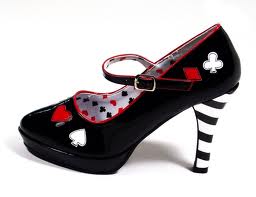
Shoes
From: homedesign.dyndns.org

 Tea set
From: examiner.com

Restaurant
From: sweetydesign.com