Rosalie Fitzpatrick on fiction and cooking without allergens: writing, editing, best of lists, reading recommendations, books, mangas, movies, TV shows, comics, quotes and recipes. All recipes focus on allergen free cooking suitable for endometriosis and pregnancy: wheat, egg, cow's milk, rye, oats, soy, almonds, peanuts, red meat and gluten free. Also, most are seafood, alcohol, yeast and nut free. All other allergen exclusions vary per recipe.
Showing posts with label Creative Ideas. Show all posts
Monday, August 6, 2012
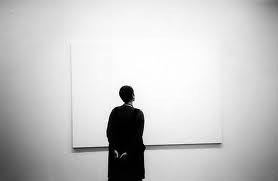
On approaching the blank sheet or screen
There is almost nothing more daunting than a blank sheet or a blank screen to a person bent on creativity. Aside from putting to ink what has only been pencil scribbles up until then, that is. Both beginning and finalising are terribly hard as beginning begs you to fill in the blank with your own thoughts and dreams, no prompting allowed, and the finalising gives you that terrible feeling you're about to be marked and judged worthless.
I say "you're" rather "your work" as for most people who've done something creative, any rejection to their work feels like a rejection of the mind and inspiration behind it rather than just of the work presented. It is all too personal. This is the reason why most people who go about rejecting works, either for a living or for fun, need to be a little gentle in their criticism. Constructive criticism is good and usually most helpful before the final stage. Downright slandering or "poo-pooing" like Matilda did the lion is just plain hurtful and doesn't really get anyone anywhere. Except maybe a pay packet for the critic and tears for the artist.
That said, this is on the beginning of creativity and less the finalising.
When starting out in writing or drawing or painting you're usually faced with a blank sheet, blank screen or blank canvas that seems to take on a life of its own. It stares back at you as though challenging you to fill it in properly and to make every word, pencil or brush stroke born of genius. There is no allowance for inept scribbling, according to the blank surface.
But far more often than not with art and writing, the work that is finally produced is actually the result of several trials and mistrials. To get a single sketch fairly finalised and ready for inking it may take several sheets of scribbles or several layers of scribbles before the image pops into being. Just as it takes several rewrites and edits for a novel to completely bloom.
The trick to getting past that blank screen or blank page stage is simple enough. You just have to realise that genius is usually born of hard work, skill is much practice and that you're only human and likely to stuff up multiple times on the way to creating anything fairly decent, not to mention gob-smacking awesome. That an boring another pair of eyes to help you see the faults and flaws in your work, especially if you're still insecure about your own skills, is how you go about creating.
That blank screen can be scribbled on and then returned to being blank or saved away for later thought. The sheet that's staring at you is likely one on top of a pile of sheets so think of it as a first draft rather than a final one and the sheet as replaceable if necessary. Canvasses are a bit more challenging as although you might have more, by the time it is set up as a blank canvas there has already been a lot of work done or a lot of money spent. So think of a canvas as an opportunity to layer those sketches and scribbles one on top of the other, followed by several coats of paint that create texture and a blending of colour you likely hadn't thought of. The same principles apply to painting a canvas as rewriting and editing the first draft of a book. It is all about adding and smoothing away and polishing.
Blank sheets, screens and canvases just need to be viewed as an opportunity rather than a challenge and from there you can play to your heart's content. As an opportunity to express yourself a blank page or canvas is enticing, especially if you have something on your mind that you'd like to show the world. And if the page or canvas is still a little daunting then just take up a pencil and scrawl a few light shapes on it, light enough that they can be rubbed away without leaving any marks behind. That way, the surface to work on isn't blank anymore and you can approach it freely.
If you're writing then just write down the conversation you just had or the lyrics of the music you just listened to or even a quote from the movie you just watched. Write down something that stuck in your mind. Then just write what's on your mind, whether its a different topic or not. Start with a feature of the world you're imagining or a character that's bumbling about in a half built world within your mind. Anything will do until your ideas begin to form properly. And anything you don't want to keep just delete once the page is no longer scary.
Thursday, June 7, 2012
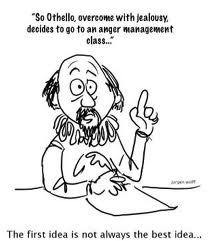
On the value of first ideas in art and writing
Many of those in the know, with regards to writing, will tell you that your first ideas should always be taken with a grain of salt or ignored. In fact, they often say that following them is a bad idea.
But there are times when I have to beg to differ on this. Sometimes the first idea you have contains the spark of genius and the necessary propulsion to carry an entire artwork, whether it is writing or visual art. The best of these to follow are your eureka moments, your epiphanies, to do with life or the imagination as these often shed light on an issue that others would be interested in. Also, they often touch on something significant.
Those first ideas you have may just need a bit of rounding out to make them usable. They may need a bit more thought than you're used to putting into an idea before it can be properly followed. Your initial idea might be simple, inelegant and possibly difficult to use as the basis of a piece of writing or an artwork. But give it a chance to build in your mind because usually the thoughts that strike you out of nowhere, the thoughts that hold your initial imaginings, are the key to filling your art with life. And art and writing are truly valuable and appreciable when there is life to be seen in it.
Of course, there are ideas you should just keep on going from and never look back at but don't discard all first ideas like that. You will miss out on some beauties.
There is something rather horrible that can come from discarding an idea that is brilliant but difficult for one that is toned down and easier to work on. And that is dullness in the final piece. A dullness that will likely lead you to starting all over again (either that or being rejected), possibly with the original idea. In restarting you have to discard all the work done up to then, if none of it is salvageable, which is a touch torturous to do.
There is another problem that can occur in restarting an imaginative piece. That is that you run the risk of producing sub-par work through being thoroughly exhausted with the whole concept. If you see this happening it is probably best to move on to another project. Don't discard all your work though as a break might be all that's needed and revisiting it later could lead to success.
The problems with first ideas, any ideas really, don't stop here though.
Like many other ideas, even brilliant first ideas are susceptible to being overworked. When any promising idea is overworking for enthusiasm it can be destroyed. Through rethinking and retouching you can make an idea bloom and take on a brilliant shape that will amaze those reading or seeing it. But there are times, which happen quite frequently, when the idea that was so worthwhile at the beginning looses all life as the writing or art becomes lifeless, staid and still through overwork.
In such circumstances, the value of rethinking and retouching a work becomes less than we'd normally like. While editing, retouching or re-sculpting come in handy, extraordinarily so in the case of writing, you have to remember that there is a point when it all goes to far.
Given that writing any full length book takes so much time and effort (much the same as making life sized brass sculptures in effort if not physical labour), it is often terrible to discover that the reworking you've done has completely destroyed the energy of the original idea, that spark that lead to writing in the first place.
Luckily, in writing, most of the reworking done is to our advantage. Language is smoothed out, a writing style formed and the structure is perfected. Much is done in reworking writing that enhances the original idea and I would never suggest forgoing editing entirely or that it lacks value. But be careful in your editing. Watch out when smoothing over the crucial points or those idiosyncrasies and flairs of imagination. They might be just what makes your work special.
The degradation reworking can cause to art is plainly obvious when you look at overworked or incorrectly worked art. Colours can still and stagnate, brush strokes are lost through overlaying, lines blur or become less organic, texture flattens out, visual perspective and sense is lost to the need for accuracy.
There are of course times when a fair amount of reworking is required to bring about an idea to its true form in art but if you touch it from then on disaster can strike. What would happen if one more chisel mark was made into David? Or many? What would happen if it was smoothed down just that tad more? How many lines and details will be lost?
And all this without it being a problem with the original idea. I'm actually more inclined to warn against over-thinking and overworking than following an initial idea. Just be sure to give careful consideration to all your ideas and, if you want to sell your work, see if they match a market out there.
Friday, April 27, 2012
Saturday, March 24, 2012
Reading chairs with a difference
From: theblogprof.blogspot.com
From: pics-site.com
From: readingkeepsyousane.blogspot.com
From: houzz.com
From: designcrave.com
From: editionsballard.wordpress.com
From: coolfunclub.blogspot.com
From: thenextbestbookblog.blogspot.com
From: TrendHunter
From: Opulent Items
(I want this one)
Labels:
books,
Carved,
Chairs,
Couches,
Crafts,
Creative Ideas,
Design,
Fiction,
Fun,
Home Decoration,
Interesting,
Reading,
Reading Chairs,
Rocking Chairs,
Sculptures,
Seats,
Unique
Friday, February 17, 2012
Best methods to rid yourself of writer's block
- Tea - fire those synapses
- Sleep - rest and rejuvenate
- A day trip - get your mind off it and have some fun/relax
- Reading - look at other people's ideas, styles, themes, worlds and think of what you'd change
- Arguing with someone on a topic of interest
- Day dreaming - write down scenarios or note what emotions drive them
- Dreams - intense dreams or nightmares can provide great plot devices, character motivations
- Observing and taking note of strange incidents
- Researching historical events or alternate lifestyles
- Hang out with your pets - relax and see that there is a great deal you don't know and can discover (if you don't know what I mean or don't have pets then just ask 'why?' at everything)
- Watch a show that makes you argue ineffectually at the television screen - write your response
- Read poetry or jokes - they often reveal a new way of looking at things
- Listen to music with a theme or story behind the lyrics - works in a similar way to poetry or jokes
- Read over what you've written already. Find where the problem started and begin writing again from there.
Subscribe to:
Posts (Atom)