Showing posts with label Starting Writing. Show all posts

Monday, August 6, 2012

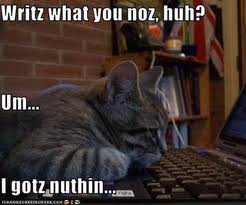
On approaching the blank sheet or screen


There is almost nothing more daunting than a blank sheet or a blank screen to a person bent on creativity. Aside from putting to ink what has only been pencil scribbles up until then, that is. Both beginning and finalising are terribly hard as beginning begs you to fill in the blank with your own thoughts and dreams, no prompting allowed, and the finalising gives you that terrible feeling you're about to be marked and judged worthless.


I say "you're" rather "your work" as for most people who've done something creative, any rejection to their work feels like a rejection of the mind and inspiration behind it rather than just of the work presented. It is all too personal. This is the reason why most people who go about rejecting works, either for a living or for fun, need to be a little gentle in their criticism. Constructive criticism is good and usually most helpful before the final stage. Downright slandering or "poo-pooing" like Matilda did the lion is just plain hurtful and doesn't really get anyone anywhere. Except maybe a pay packet for the critic and tears for the artist.

That said, this is on the beginning of creativity and less the finalising.


When starting out in writing or drawing or painting you're usually faced with a blank sheet, blank screen or blank canvas that seems to take on a life of its own. It stares back at you as though challenging you to fill it in properly and to make every word, pencil or brush stroke born of genius. There is no allowance for inept scribbling, according to the blank surface.


But far more often than not with art and writing, the work that is finally produced is actually the result of several trials and mistrials. To get a single sketch fairly finalised and ready for inking it may take several sheets of scribbles or several layers of scribbles before the image pops into being. Just as it takes several rewrites and edits for a novel to completely bloom.


The trick to getting past that blank screen or blank page stage is simple enough. You just have to realise that genius is usually born of hard work, skill is much practice and that you're only human and likely to stuff up multiple times on the way to creating anything fairly decent, not to mention gob-smacking awesome. That an boring another pair of eyes to help you see the faults and flaws in your work, especially if you're still insecure about your own skills, is how you go about creating.


That blank screen can be scribbled on and then returned to being blank or saved away for later thought. The sheet that's staring at you is likely one on top of a pile of sheets so think of it as a first draft rather than a final one and the sheet as replaceable if necessary. Canvasses are a bit more challenging as although you might have more, by the time it is set up as a blank canvas there has already been a lot of work done or a lot of money spent. So think of a canvas as an opportunity to layer those sketches and scribbles one on top of the other, followed by several coats of paint that create texture and a blending of colour you likely hadn't thought of. The same principles apply to painting a canvas as rewriting and editing the first draft of a book. It is all about adding and smoothing away and polishing.


Blank sheets, screens and canvases just need to be viewed as an opportunity rather than a challenge and from there you can play to your heart's content. As an opportunity to express yourself a blank page or canvas is enticing, especially if you have something on your mind that you'd like to show the world. And if the page or canvas is still a little daunting then just take up a pencil and scrawl a few light shapes on it, light enough that they can be rubbed away without leaving any marks behind. That way, the surface to work on isn't blank anymore and you can approach it freely.


If you're writing then just write down the conversation you just had or the lyrics of the music you just listened to or even a quote from the movie you just watched. Write down something that stuck in your mind. Then just write what's on your mind, whether its a different topic or not. Start with a feature of the world you're imagining or a character that's bumbling about in a half built world within your mind. Anything will do until your ideas begin to form properly. And anything you don't want to keep just delete once the page is no longer scary.

Wednesday, May 2, 2012

On writing what you know

There is a piece of advice often given to new writers that goes like this: "Write what you know".


Does this make you feel limited? Probably so, as you're wondering just what you know well enough to write about anyway.
Any less daunted? Not really, as you don't know yet how to construct a book properly because you haven't yet done it so how do you know about any of it anyway.
Wondering if you know anything well enough? Probably.
Feeling suddenly stupid and worthless? Likely.

Oh, the self defeating thoughts do go on, don't they. It is just one of those things humans are particularly good at. 

But having such thoughts isn't something you should ignore Just as the advice of writing what you know isn't something you should ignore. Your self defeatist attitude is just another piece of writing fodder so store it away and look into yourself for what else you've experienced.

What you know from the very start that can be used to write a book will be a list something like this:

  • You know yourself enough to know you want to give writing a go. 
  • You know you friends and family enough to deal with them (I say deal as not everyone gets along fabulously).
  • You know the animals around you enough to deal with them too. 
  • You know your history.
  • You know pain, love, fear, desire, logic and a lack of logic, the complexity of life, hunger, greed... etc.
  • You know how people normally react in certain situations.
  • You know basically what rules of the universe can and can't be broken.
  • You know beauty and ugliness.
  • You know what it feels like to dream and to wake. 
  • You know what it is to be a victim.
  • You know what it is to be a winner.
  • You know what it is to be adventurous or foolhardy, to take risks on a whim and ignore advice.
  • You know the balance between bravery and terror, between self-defeatism and rebellion, love and hate.
Again, the list could go on. And it doesn't even include any of the skills you've built up over your years of studying and life experience. When appreciating the advice of write what you know always start at the foundations of what it is to be human. If you remember that you are constructing humans or understandable beings out of words then you should be able to get started in constructing characters.


Also, don't forget that you don't have to write exactly the circumstances you experienced to gain any of this knowledge. As with most fictional writing, it is that you express these emotions through your characters and express your understanding of the world that is important. Not the grounded realism of the event or circumstance. Readers want to look into the soul and mind, not read a list of this happened and then that happened.

So everything you've ever experienced is fodder. Make your characters do whatever they need, move about on their own logic (not the narrator's or yours), see the world through their own ideas with their own mental restrictions. And you can do it because you know what it is to be blinkered and not know everything that is going on around you. You should be able to construct an appealing character just by applying these vulnerabilities.

If you don't know or understand yourself and others in this way then writing isn't your art. There are other arts out there, other crafts and ways to be creative that will likely suit you better and make you happier than slogging away at making your characters real when you can't grasp enough information to base them on. All value in creativity does not lie in writing, in fact it might be far more useful to humanity as a whole to be creative in math or science.


The reason why this advice is so useful to those starting out is it doesn't just advise you on character construction but also world construction and on genre. This is the bit that involves your skills and knowledge, the bit that had you feeling quite miserable.

If you have absolutely zip of an idea about basic science then please, whatever you do, do not try to write science fiction unless you are completely prepared to learn a lot through research and apply it. Without adequate scientific knowledge your world construction will not be believable enough for the avid fans of the genre. If you cannot imagine fantasy scenes in other people's works and dislike the illogical flights of fancy then please do not write fantasy as in fantasy you will have to explore in-depth all that you didn't understand and dislike. Your dislike and inability to connect will transfer through to the tone of the text and destroy all the good work you put into it.

Writing what you know in terms of skills doesn't just mean write on what you have studied well but also write on what you appreciate and understand. Usually, you will find an indication of your interests in the types of books you read. Now, not everyone reads only one or two genres. Sometimes a reader reads multiple genres.


I myself have read and continue to read from these:
  • Fiction
  • Literature
  • Horror
  • Fantasy
  • Science Fiction
  • Biography
  • History
  • Historical Fiction
  • Alternate History
  • Crime
  • True Crime
  • Mystery
  • Popular Science
  • Comedy/Humour
  • Comics
  • Manga
  • Plays
  • Poetry
  • Romance
  • Classics
  • Theses
  • Journals
You probably now understand the problem I faced when deciding which genre I should write in. But to jump start you ahead of where I was, look at the books you have collected. Which ones are your favourites? Which ones do you understand the most with regards to back stories, genre trends, plot devices and character construction? Which type of book have you collected above all the others?

For me it ended up being fantasy, science fiction and horror with a fair smattering of crime, true crime, mystery and popular science. So what else was there for it but to chuck them all in a blender along with bits and pieces of a few others and see what came out?

The only problem you will face when writing a book without a distinct genre is that many publishers won't know what to do with it. But you can still write it and hope a publisher will pick it up. One way to encourage a publisher to pick up your work is to make sure you directly and unwaveringly target a specific audience. Don't write while you are unsure of how it will sell or read if you want it to be bought and read by the masses of readers out there. Do if you don't mind taking the time to test yourself and cut your teeth on something, saleable or not.


If you only come up with one or two genres to pick from with regards to your favourites and most collected then you should find it easy to start writing. An audience is already out there that appreciates just plain crime, romance or horror, for example. There are also pre-prepared audiences for paranormal romance (fantasy combined with romance), science fiction and fantasy blends, science fiction or fantasy combined with crime and so on. Between two genres most blends have been successfully explored and sold so an addition to these shouldn't be hard to sell to a publisher as long as it is appealing and well written. 

Side note: Don't blame the publisher for their not picking up your work as they run a business based on continual high-stakes gambling and will generally only pick those books they believe will give them a good return on their investment. They won't publish just anything in hope of a sale. As with most forms of gambling there are methods to make sure you come out even or on top and these methods are applied by publishers, and not just through pickiness. It is up to you to provide them with a fantastic piece that's also saleable.


As to world construction, familiarity with not only a subject but with what it is to be human should allow you to build a complex world for your complex characters. To start out the world is best constructed from your knowledge on a subject, whether you gathered it recently through research or through years of study and experience. Just as your characters become the most life-like and appealing if they reflect your own experiences. Genre is easily governed by the world you've constructed through knowledge and preferences even if you cannot pick which genre to approach before constructing a world.

From here, the writing, editing, submitting, rejection, rejection, rejection and possibly finally acceptance falls on you. It isn't anyone else's fault what you write, how acceptable it is, if it is unaccepted, if it is but doesn't sell well or anything else. It is yours (unless the publisher is one of those dodgy ones designed to take an author's money and do little else - yes there are dodgy little companies out there so watch out). But the good thing is that even if you fail you can dust yourself off and keep on going to find success, as long as you haven't managed to offend everyone about you in the process of being rejected. So be nice and keep writing.